

Are your game nights stuck on repeat with the same old favorites? If you’re looking for a game that’s more about clever predictions than pure luck, it’s time you learned the card game Chicago. It’s a fantastic choice for friends and family, blending simple rules with a surprisingly competitive edge that will have everyone leaning in, round after round. Check out ufa14k to know more
What is the Chicago card game at its heart? It’s a game where you bet on your own success. Before each hand is played, you’ll look at your cards and make a bold prediction: exactly how many rounds, or “tricks,” you believe you can win. The real fun comes not just from having the best cards, but from the thrill of seeing if your prediction comes true. Getting it right feels like a stroke of genius; getting it wrong is a hilarious, table-flipping disaster.
You don’t need to know a thing about “tricks” or “bidding” to get started. This guide offers a clear, step-by-step approach that covers everything from the setup to scoring your first win. You’ll be ready to deal the cards and introduce a new favorite to your game night rotation tonight.
Your Quick Setup Guide: What You Need to Play Chicago
Getting started with Chicago is incredibly simple. You only need a few common household items to be ready for your first game, which means you can go from reading this article to playing in just a few minutes.
Here’s your complete checklist:
- A standard 52-card deck (no jokers needed).
- 2 to 4 players (the game really shines with four).
- A piece of paper and a pen to keep score.
With your gear assembled, the game’s core concepts are just as easy to grasp. Chicago uses the familiar card ranking you already know: Ace is the highest, followed by King, Queen, and so on, down to the 2. The ultimate goal is to be the first person to reach a set score, often 50 points. You’ll earn these points over several rounds by playing your cards cleverly.
The Flow of the Game: Understanding the Four Steps of a Round
Each game of Chicago is built from a series of rounds. The beauty of the game is that every single round, from the first to the last, follows a simple and predictable four-step pattern. Once you learn this rhythm, you’ve learned the core of how to play Chicago.
This recurring cycle gives the game its structure. Here are the four phases you’ll go through in every round:
- The Deal: The dealer passes out the cards for the round.
- The Bid: Players look at their hands and predict how many tricks they’ll win.
- The Play: Everyone plays their cards, one at a time, to try and win tricks.
- The Score: Points are awarded based on how accurate your bid was.
After scoring, a new player deals, and the cycle begins again! This loop continues until one player reaches the target score, making every round feel like a fresh start.
How to Win a Round: The Art of Playing and Winning a “Trick”
The “Play” phase of the game is where all the action happens. It’s made up of a series of mini-showdowns called “tricks.” A trick is simple: starting with the player to the dealer’s left, everyone plays one card to the center of the table. The person who plays the highest card wins the trick, collects the cards, and places them face-down in a personal pile. Your goal is to win the number of tricks you promised to win during the bid.
Playing a trick follows one fundamental rule: you must follow suit. This means if the first player leads with a Heart, every other player must also play a Heart if they have one. You can play any Heart you want—high or low—but it must be a Heart. The highest card of the suit that was led wins the trick. The winner of that trick then gets to lead the first card for the next one.
But what happens when you can’t follow suit? For example, if a Heart is led but you have no Hearts left in your hand? This is where Chicago’s most important rule comes into play. In this game, Spades are always the trump suit. A trump card is like a secret weapon that can beat any card from any other suit. If you can’t follow suit, you are free to play any card from your hand, including a powerful Spade.
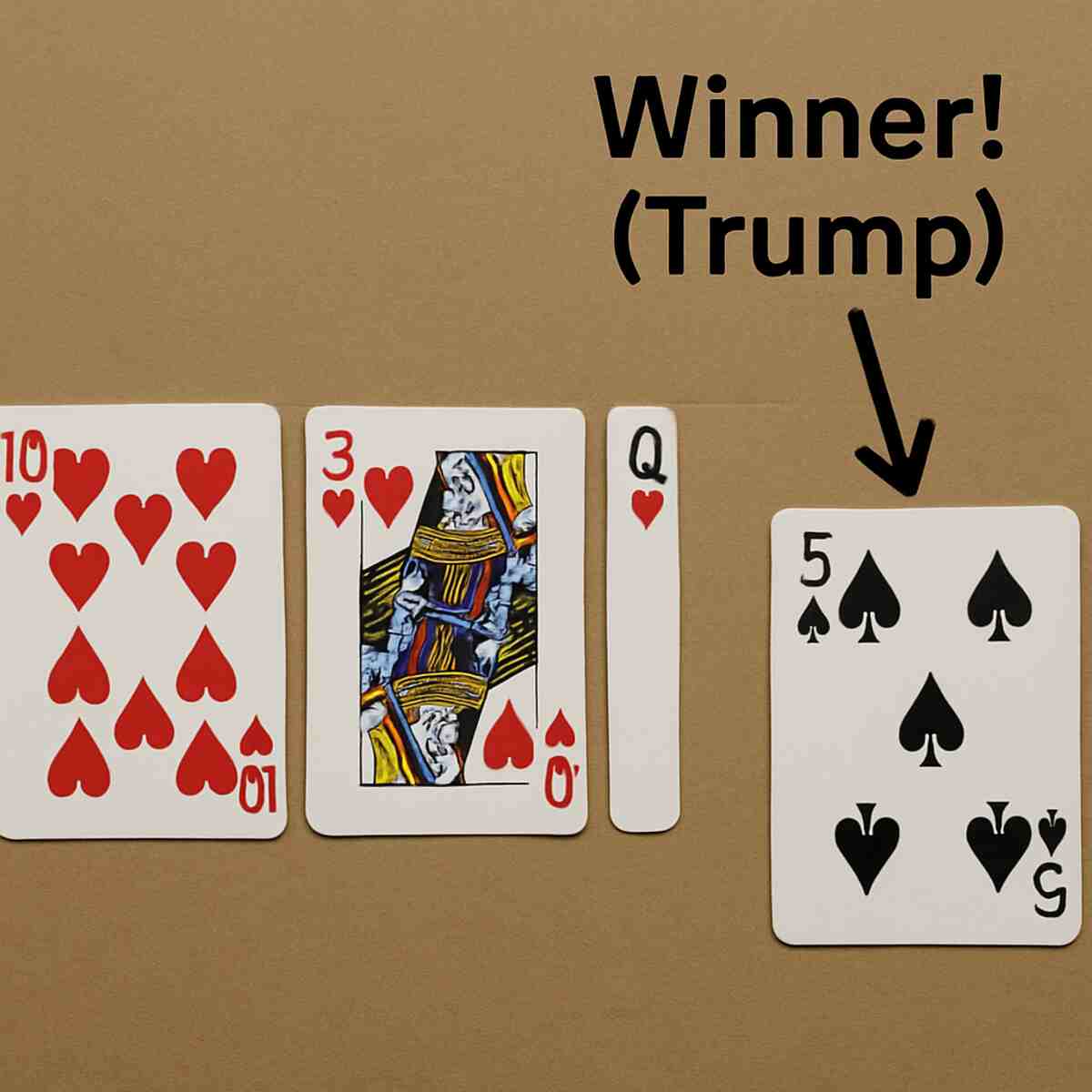
For example, even a low Spade can win a trick against high cards of another suit. If Anna leads with the 10 of Hearts and other players follow with the 3 and Queen of Hearts, they are all playing correctly. But if David has no Hearts and plays the 5 of Spades, his low Spade trumps everything else and wins the trick. Understanding this rule is the key to knowing which tricks you can win and forms the basis for the game’s most strategic element: the bid.
Making Your Promise: How to Bid with Confidence
Knowing how to win a trick is only half the battle. Before any cards are played, you have to make a promise. This is called the “bid,” and it’s your prediction for how many of the upcoming tricks you believe you will win. Think of it less as a bet and more as setting a personal goal for the round. The game isn’t just about winning the most tricks, but about accurately predicting your own success. Your bid is your chance to look at the cards you were dealt and declare, “I think I can win this many.”
So, how do you make an educated guess? The best strategies for winning at Chicago start with a quick scan of your hand for powerhouse cards. A simple way to estimate your bid is to count your “sure things.” Look for any Aces, as they are the highest card in their suit. Also, count your high Spades (like the King, Queen, or Jack), since Spades are the trump suit. If you have the Ace of Diamonds and the King of Spades, a bid of “two” is a very reasonable promise to make.
Once you’ve assessed your hand, the bidding process begins. Starting with the player to the left of the dealer and moving clockwise, each person announces their bid out loud. Your bid can be anything from “zero”—if you have a particularly weak hand—all the way up to a daring promise to win every single trick. After everyone has made their declaration, the promises are locked in. With all bids on the table, it’s time to play the hand and see who can deliver on their word.
How to Keep Score: The Simple Points System in Chicago
After the last card is played, it’s time to tally the points. The scoring system is what makes the game so exciting because it doesn’t just reward you for winning tricks—it rewards you for accurately keeping your promise. This is where your careful predictions can pay off in a big way.
Scoring in Chicago is wonderfully straightforward. In each round, you calculate a player’s score using a simple, two-part system:
- +1 point for every trick you win.
- +10 bonus points if you win exactly the number of tricks you bid.
- -10 penalty points if you win more or fewer tricks than you bid.
This bonus-and-penalty structure creates all the game’s tension. For instance, if you bid “Two” and win exactly two tricks, you earn a fantastic 12 points (2 for the tricks + 10 bonus). But if you bid “Two” and only win one trick, your score for the round is a painful -9 points (1 for the trick – 10 penalty). A single misstep can even land you in negative territory, making every bid a thrilling risk-reward decision.
Let’s Play! A Walkthrough of a Full Sample Round
Seeing the rules in action is the best way to learn, so let’s walk through a complete round. Imagine four friends—Anna, Ben, Chloe, and David—are playing. For this round, following standard five-card rules, Anna deals five cards to each player. After looking at their hands, it’s time to bid.
Ben, sitting to Anna’s left, has a couple of high cards and confidently bids “Two.” Chloe, holding a mediocre hand, cautiously bids “One.” David, seeing nothing but low cards, decides his best strategy is to avoid winning anything and bids “Zero.” Finally, Anna looks at her hand, sees an Ace, and also bids “Two.”
With the bids locked in, Ben starts the first trick by leading a King of Hearts. Chloe and David both follow suit by playing lower Hearts. Anna, however, has no Hearts. This allows her to play a trump card—a Spade. Even though she plays a lowly 3 of Spades, it beats the King of Hearts, and she wins the trick. This move perfectly illustrates how trump cards can change the game.
After all five tricks are played, the round is over. Anna, despite her bid of “Two,” ended up winning three tricks. Ben, however, nailed his prediction, winning exactly two tricks. Both Chloe (who bid “One”) and David (who bid “Zero”) failed to win a single trick.
Now for the scoring. Ben receives 12 points (2 for his tricks + 10 bonus). David, by successfully winning nothing, also gets a 10-point bonus. Unfortunately, Anna’s extra trick means she missed her bid, so she gets 3 points for her tricks but a -10 penalty for a total of -7. Chloe also gets a -10 penalty. This round shows that accurately predicting your success is the true key to winning.
The All-or-Nothing Gamble: What Does “Going Chicago” Mean?
That high-stakes bet has a special name: a “Chicago.” When a player feels they have an unbeatable hand, they can declare a Chicago bid. This isn’t just a promise to win most of the tricks—it’s a bold declaration that you will win every single one of them. It’s the game’s ultimate power move, turning a regular round into a nail-biting, all-or-nothing showdown.
The reward for this incredible feat is just as dramatic. If you successfully pull off a Chicago bid and win all the tricks, you receive a massive 52 points. In a game where the target score is often 50 or 52, winning a Chicago can end the entire game in a single, glorious round. It’s the fastest and most memorable way to win.
Of course, a gamble this big comes with a monumental risk. If you bid Chicago and fail to win even one trick, the penalty is equally severe: you lose 52 points. This devastating blow can instantly send you from the lead to last place. This is what makes the Chicago bid so thrilling—it’s a high-wire act where a single mistake can lead to a spectacular fall.
Don’t Get Caught! How to Avoid 3 Common Mistakes
As you get the hang of the game, a few common traps can quickly turn a winning hand into a losing round. The most important rule to remember is that you must always “follow suit.” If a player leads with a Heart, you must play a Heart if you have one. Playing a card from another suit when you could have followed the lead is called a renege, and it’s a serious error.
Another classic pitfall is over-bidding your hand. It’s easy to get excited when you see an Ace and a King, but optimism can be your downfall. A hand with the Ace of Clubs and King of Clubs is a strong contender for two tricks, but bidding “three” without a third guaranteed winner is a risky gamble that often backfires.
Finally, a common mistake is forgetting the power of Spades. No matter how high your card is, it cannot beat a Spade if Spades aren’t the suit that was led. The Ace of Diamonds feels like a sure winner, but if an opponent plays even the lowly 2 of Spades, you’ve just lost the trick.
Steering clear of these simple errors is more than half the battle. By following suit, bidding realistically, and always respecting the power of Spades, you’ll avoid needless penalties and play a much smarter game.
Three Simple Tips to Start Winning at Chicago
Winning at Chicago often comes down to a few key insights. The first and most important is to treat high Spades like gold. Since Spades can beat any card from any other suit, holding the Ace or King of Spades is like having a guaranteed trick in your pocket. When you’re deciding what to bid, count these high Spades as near-certain wins.
A “zero” bid, on the other hand, requires a completely different mindset. It might seem like a passive goal, but it demands an active strategy of “losing” effectively. Your goal is to shed your high-value cards as quickly and safely as possible. For instance, if another player leads a Diamond and you have none, that’s a perfect opportunity to discard your Ace of Hearts. By throwing away your winners on tricks you can’t win anyway, you protect your zero bid.
Finally, you can gain a huge advantage by paying attention to which major cards have already been played. You don’t need to memorize every card, but just keeping an eye on the Aces and high Spades can transform your game. If you see the Ace and King of Spades hit the table early in the round, your Queen of Spades suddenly becomes the most powerful card in play.
Putting these simple ideas into practice—valuing your Spades, playing defensively for a zero bid, and watching for key cards—will dramatically improve your results.
5-Card vs. 7-Card: Which Version Should You Play?
You may find that some groups play with five cards per person while others deal out seven. The great news is that these are simply two common variations, and the core rules—bidding, taking tricks, and Spades being trump—are identical in both. The only thing that truly changes is the feel of the game and the difficulty of predicting your hand’s strength.
A 5-card hand gives you very little information, which makes bidding feel more like a fun gamble. Because your hand is so small, one or two high cards can have a massive impact, making bold “zero” or “three” bids both risky and exciting. With a 7-card hand, however, you have a much clearer picture of what you can accomplish, making the bidding process more strategic and less about luck.
So which version is right for you? If you’re looking for a faster, more unpredictable game with wild swings, 5-card is a fantastic choice. For a more calculated and strategic session, the 7-card game, sometimes known as Swedish Chicago, is often preferred. We recommend starting with five cards for your first few rounds and then trying seven to see which your group enjoys more. No matter which you pick, the fundamentals are the same.
Ready to Play? Your First Game Awaits
You now have the blueprint for mastering Chicago, from dealing the first hand to making a game-winning “Chicago” bid. You understand how to score, how to win tricks with powerful Spades, and how to bid with confidence. A standard deck of cards has been transformed into an arena for strategy and suspense.
Your next step is simple: play. Don’t worry about getting everything perfect on the first try. The real fun of learning Chicago isn’t in memorizing every rule, but in the experience—the bold zero bid that pays off, the groan when a trump card steals a trick, and the cheer when someone successfully pulls off an all-or-nothing gamble. Each round builds confidence and creates a story. Have fun, and good luck with your bids!
